Managing potyvirus disease on zucchini in Australia
02 Dec 2025
Introduction
Virus disease is a major limiting factor to zucchini production in Australia. The major cause of loss is by three viruses spread by aphids and belonging to a virus group called potyviruses.
Papaya ringspot virus-type W (PRSV-W) is the main virus found in Queensland while Zucchini yellow mosaic virus (ZYMV) dominates in Western Australia. Watermelon mosaic virus (WMV) occurs in all regions and has been particularly prevalent in the Swan Hill area in Victoria.
Rapid aphid transmission and the abundance of host crops frequently results in very high disease levels by early flowering. Affected crops have reduced fruit set and high numbers of deformed unmarketable fruit. Due to aphids being able to spread these viruses in feeding times of less than one minute insecticides are seldom effective in reducing virus spread and crop hygiene to reduce inoculum levels is often poorly implemented.
Over the last decade or so considerable investment has been made by seed companies in developing C. pepo varieties with tolerance to the potyviruses and in some instances to Cucumber mosaic virus. Several genes such as Prv and zym have been used in various combinations. The varieties are tolerant not highly resistant in that plants do become infected following either aphid inoculation or sap inoculation in greenhouse tests. The value of the varieties is their capacity to produce good yields of saleable fruit under considerable virus pressure.
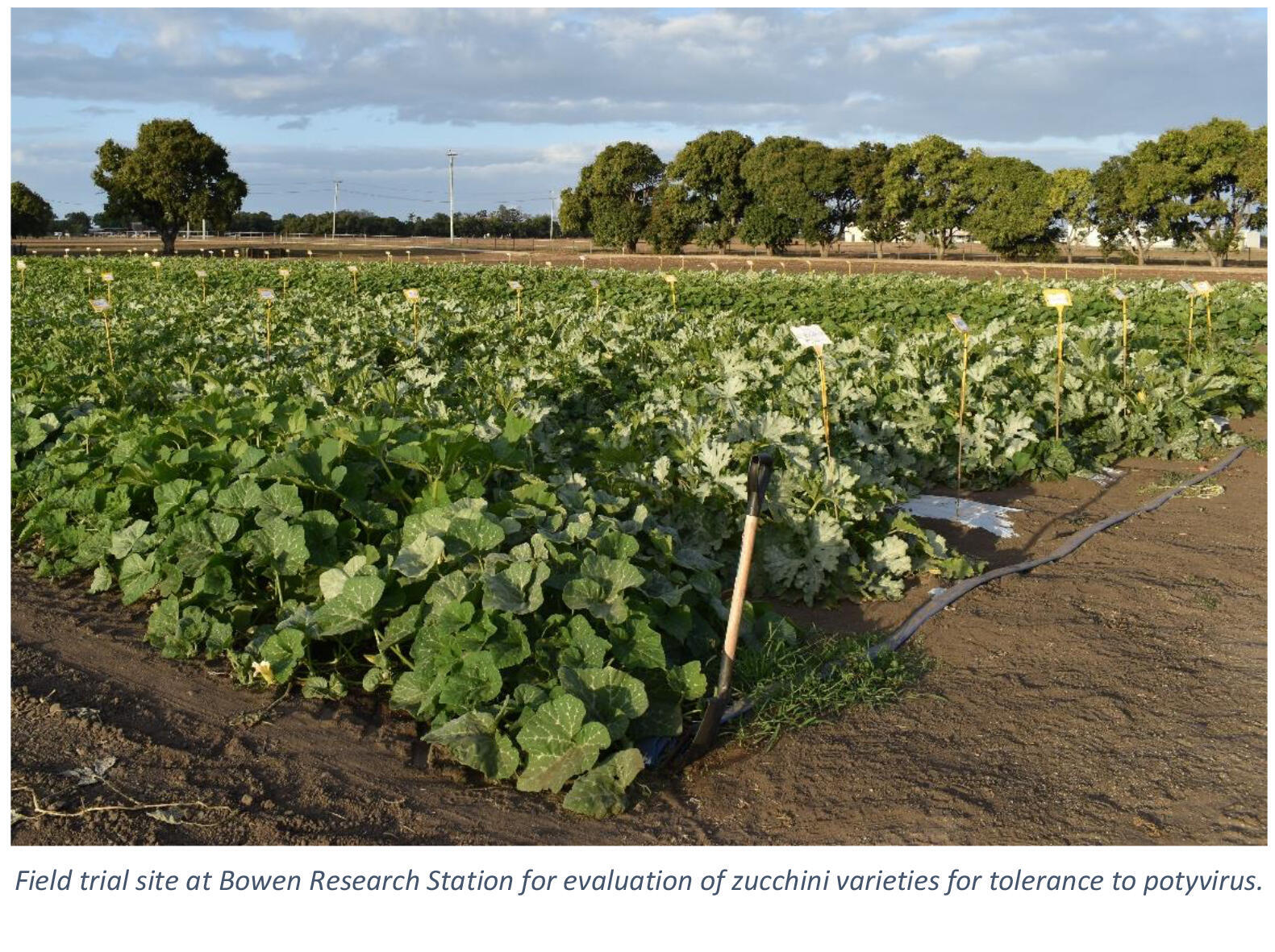
Previous work some five years ago had demonstrated the value of tolerant zucchini varieties in reducing the impact of virus disease in the crop. In project VG 16086, the work has been expanded and new generation varieties compared with those previously available. Three trials have been completed in 2019, at Gatton (January, DAF QLD), Bundaberg (April-June, Agreco Australia) and Bowen (August-September, Prospect Agriculture). The aim was to assess varieties for tolerance/ performance in the presence of PRSV.
Methods - summary
Trial design was four replicates with single row plots with 10 plants/ plot at 0.5m spacing. Squash plants inoculated with PRSV were used as virus reservoirs to allow aphid transfer to test plots. Test plants were not directly inoculated with virus. There were 16 varieties in the Gatton trial; 12 at Bundaberg and 27 at Bowen.
Data were collected on virus incidence, symptom severity on plants and fruit and aphid populations. Virus severity was rated using a 0-7 scale with 1=very mild symptoms and 5 to 7 severe to very severe symptoms. Yield data were collected on at least three occasions in each trial. Total yields, yields of marketable fruit and severity of virus symptoms on fruit were measured. Selected symptomatic plants were sampled for molecular testing for PRSV, ZYMV and WMV to determine their virus status.
Results - summary
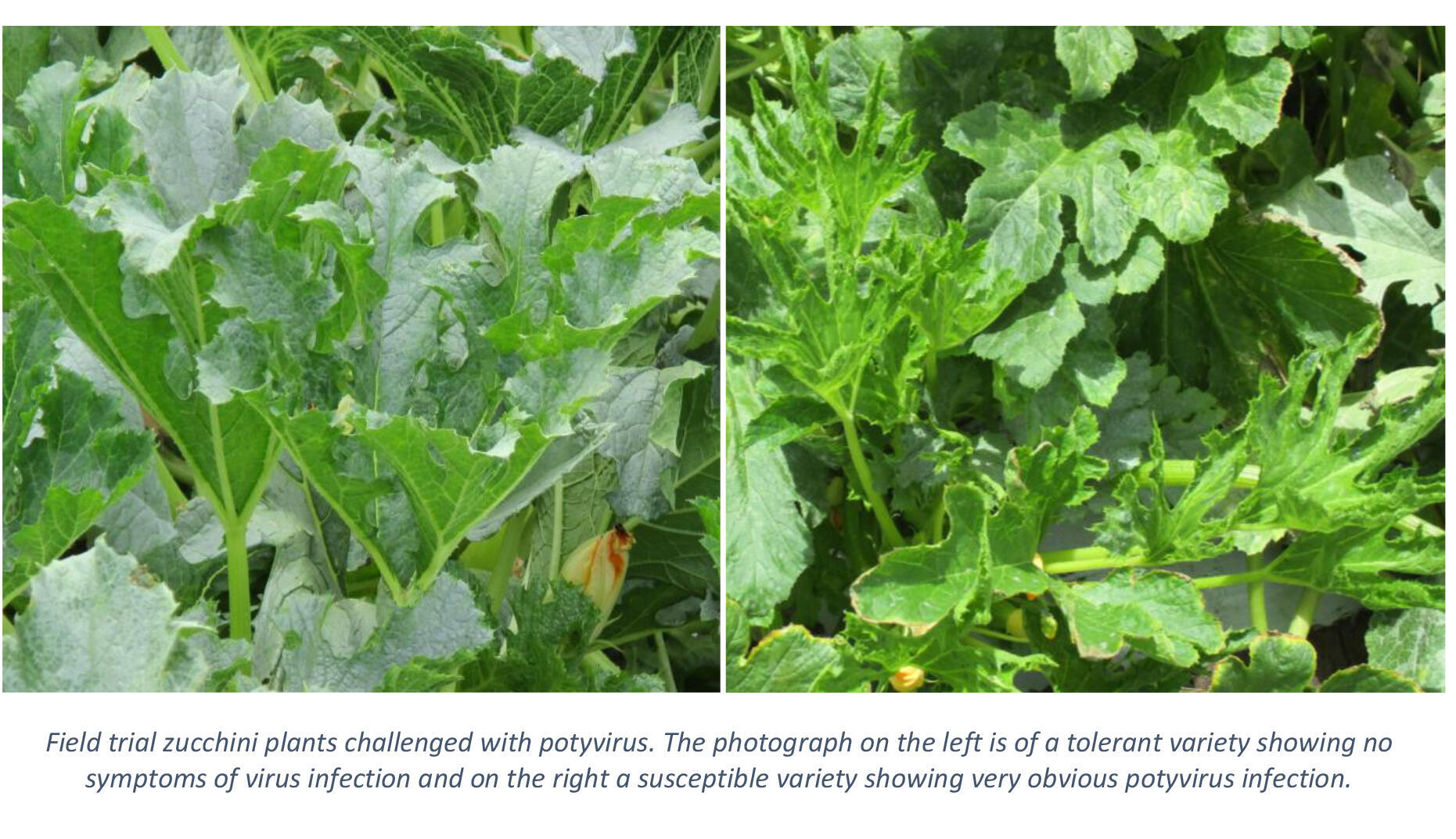
Varieties ranked as highly tolerant over three trials were Desert, Apollonia, Alessandra, Ebano, 003-6, Baily
These varieties developed only very mild leaf symptoms and had few if any fruit symptoms. This tolerance was reflected in high yields of marketable fruit with little wastage.
Varieties with intermediate tolerance were: Seduction, Rosa, Eva, Pascola
These varieties developed leaf symptoms of intermediate severity (2-3 on severity scale). Moderate virus symptoms were seen on a proportion of fruit.
Susceptible varieties included Regal Black and Amanda. Varieties in this group had leaf and fruit symptoms 5 to 7 on the severity scale.
The only virus detected in symptomatic plants tested by molecular assays was PRSV.
Conclusions
At least six zucchini varieties have been identified as having excellent tolerance to PRSV in Queensland. All are worth evaluation by growers on their own properties to decide which varieties are best suited to the local environment and market requirements. It is likely that the varieties highly tolerant to PRSV will also perform well against ZYMV but this needs to be demonstrated in trials in WA and elsewhere. Arrangements to do this have been made.
Key points for virus management
While virus tolerant varieties are a valuable tool for virus management they should be used as part of an integrated approach to delay virus infection and reduce the overall virus levels in crops. Actions which help reduce movement of the aphid vectors into crops or between crops is a very positive step towards managing disease caused by potyviruses.
Measures which can be used include:
- destroy harvested or abandoned cucurbit crops as soon as practically possible. These crops are very important sources of potyvirus and aphids on farm and within the district. Undertaking this across neighbouring farms or across a production area will have greater positive impact.
- separate new crops from maturing crops where possible. Separating crops by as little as 50 to 100 m can be beneficial and planting new crops upwind from older crops can also help
- separate cucurbit crops using blocks of unrelated non-host species
- consider tall barrier crops to separate blocks
- use and select insecticides with caution. None are registered for control of virus diseases as mostly they have no useful effect on the spread of potyviruses by the aphids. Instead, they can have a negative effect if they disrupt natural enemies and make the plants less pleasant for the aphids to feed on which increases their movement through the crop. If the aphids move around a lot tasting plants instead of settling and feeding, they will spread the virus as they go resulting in more disease.
- applying refined mineral oils and planting into reflective plastic mulch can reduce or delay virus infection but results are variable. Their effectiveness depends on factors like frequency of application to ensure new leaves are protected and rate of crop growth over mulched rows.
Further information
For further information please contact Denis Persley (Denis.persley@daf.qld.gov.au) or Mobile 0402 331 384
Or the Project Leader: Cherie Gambley (cherie.gambley@daf.qld.gov.au) or Mobile 0423 200 211
This project has been funded by Hort Innovation using vegetable industry levies and contributions from the Queensland Department of Agriculture and Fisheries; Victorian Department of Economic Development, Jobs, Transport and Resources; The Northern Territory Department of Primary Industry and Resources; the Western Australia Department of Primary Industries and Regional Development and the University of Tasmania. It is supported by a second smaller project led by the New South Wales Department of Primary Industries and similarly funded by Hort Innovation using vegetable industry levies and contributions from the New South Wales Department of Primary Industries.


Share:


